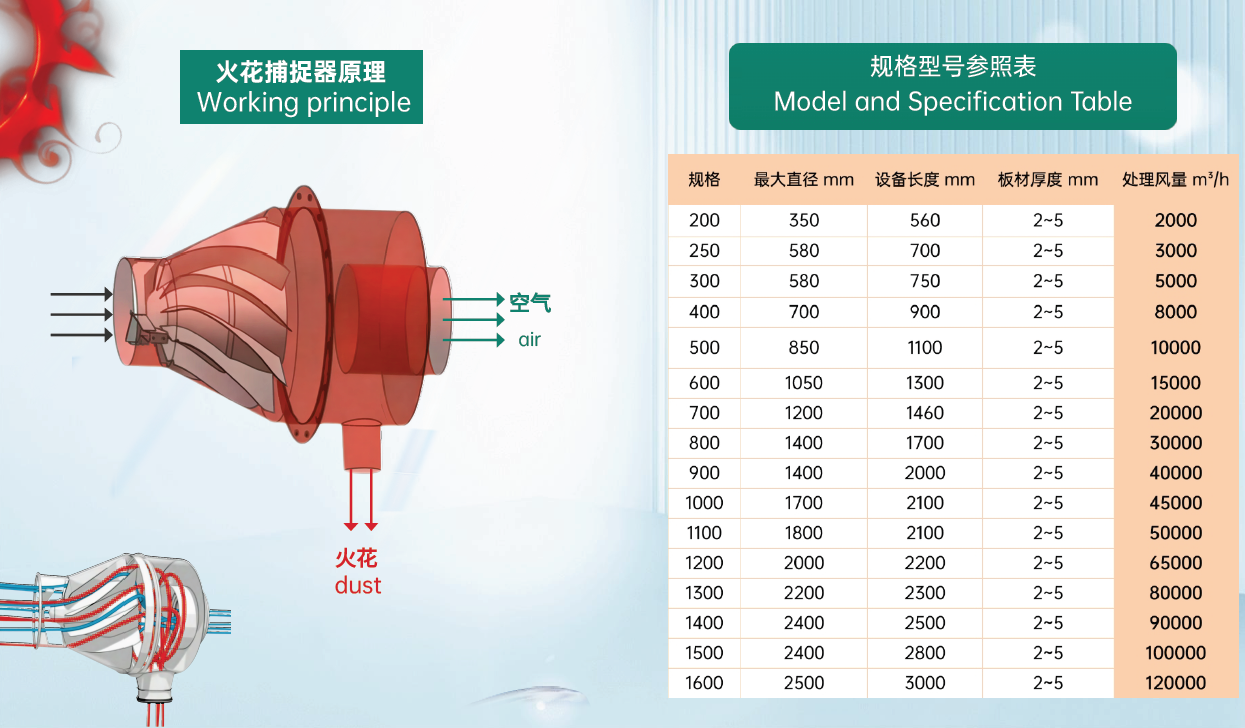

A spark trap (also called a spark separator or spark arrestor) is a safety device used in dust collection systems to remove or extinguish hot sparks and burning particles before they enter the main dust collector. Its primary purpose is to reduce the risk of fire or explosion in systems that handle combustible dust.
Spark traps are especially important in industries such as woodworking, metal grinding, grain processing, and recycling, where operations can easily generate high-temperature particles that travel through ducting.
Working Principle of a Spark Trap
A spark trap works by using physical airflow changes and mechanical separation to remove ignition sources from the airstream. Unlike filters, it does not rely on fine filtration media. Instead, it uses gravity, inertia, and airflow dynamics.
1. Airflow Direction Change
When dusty air enters the spark trap, it is forced to change direction rapidly.
- Air can follow the duct path easily
- Heavy sparks and burning particles cannot
- These particles lose momentum and fall into a collection chamber
This simple but effective method is one of the most common designs.
2. Centrifugal Separation (Cyclonic Effect)
Many spark traps create a swirling or cyclonic airflow inside the chamber.
- The air spins at high speed
- Heavier particles are pushed outward by centrifugal force
- Sparks are separated from the clean airflow and drop down
3. Gravity Drop Zone
After separation, sparks lose energy and fall downward into a holding chamber.
- Hot particles cool as they travel
- Gravity pulls them away from the airflow
- They are safely collected before reaching filters
This prevents burning debris from contacting filter bags or cartridges.
4. Cooling and Extinguishing Effect
Inside the spark trap, airflow is often slowed or redirected through metal surfaces.
- Heat is transferred to the trap walls
- Sparks are exposed to cooler air
- Oxygen supply is reduced in confined zones
As a result, sparks often extinguish before leaving the device.
5. Collection and Maintenance Chamber
The separated material is stored in a lower chamber or hopper.
- Prevents re-entrainment into airflow
- Can be periodically emptied
- Ensures continuous protection of downstream equipment
Regular cleaning is important to maintain efficiency and avoid buildup of combustible material.
Why Spark Traps Are Important
Spark traps serve as a first-stage fire prevention device in dust collection systems. Their importance lies in stopping ignition sources before they reach sensitive equipment.
Key benefits include:
- Reducing fire risk in dust collectors
- Protecting filter bags and cartridges from burning damage
- Improving overall system safety
- Supporting compliance with industrial fire safety standards
Typical Applications
Spark traps are widely used in systems where hot particles are likely to be generated:
- Woodworking and furniture production
- Metal cutting, grinding, and welding operations
- Grain and agricultural processing
- Paper and textile industries
- Recycling and waste handling facilities
Spark Trap vs Other Safety Devices
It is important to distinguish spark traps from other dust collection safety systems:
- Spark trap: Removes ignition sources before they enter the dust collector
- Explosion vent panel: Releases pressure during an explosion
- Explosion isolation valve: Stops flame propagation between equipment
- Explosion suppression system: Detects and extinguishes explosions instantly
A spark trap is preventive, while many other devices are protective or reactive.
Conclusion
A spark trap is a simple but essential safety component in dust collection systems. By using airflow redirection, centrifugal separation, gravity, and cooling effects, it removes or extinguishes sparks before they can reach the dust collector. This significantly reduces the risk of fire and improves the overall safety of industrial dust handling systems.