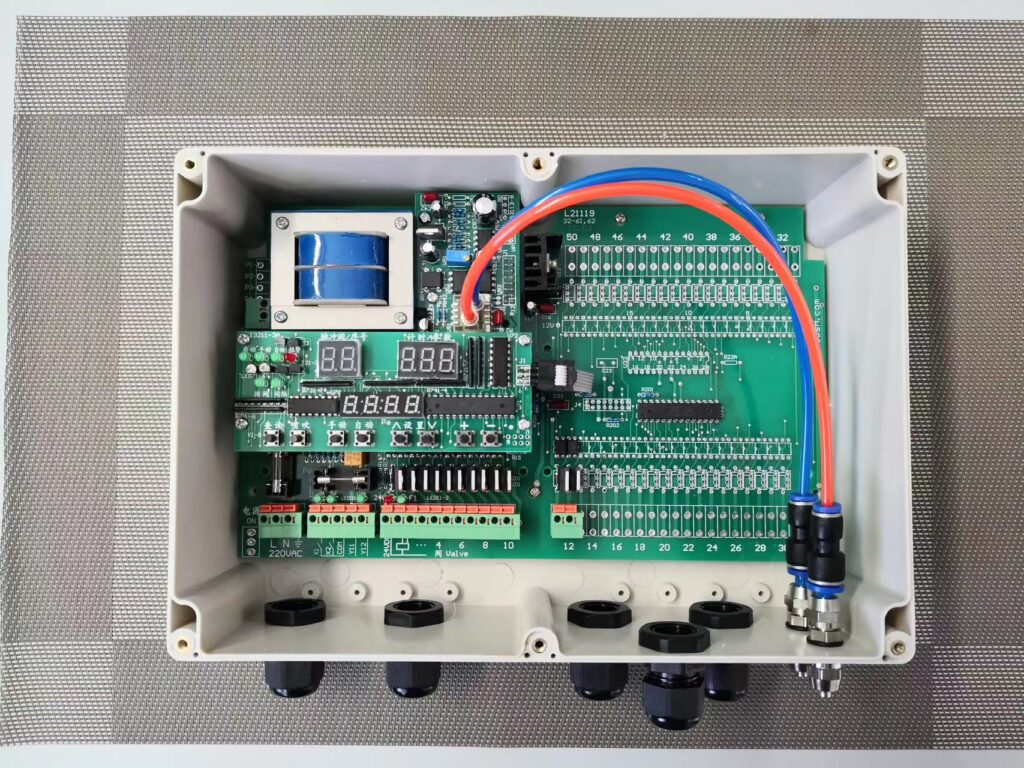

A Differential Pressure (DP) Controller is an important control device used in dust collection systems to monitor and manage the pressure difference between the clean air side and the dirty air side of a filter.
It helps ensure that the dust collector operates efficiently, protects filter bags or cartridges, and maintains stable airflow throughout the system.
Basic Concept of Differential Pressure
In a dust collector, air passes through filter media that traps dust particles. As dust accumulates on the filters, resistance increases.
This resistance creates a pressure difference (ΔP):
- Dirty air side (inlet) → higher pressure
- Clean air side (outlet) → lower pressure
The difference between them is called differential pressure:
ΔP = P_dirty − P_clean
When filters get clogged, ΔP increases.
What Does a Differential Pressure Controller Do?
A DP controller continuously measures this pressure difference and uses it to control system operations.
It typically:
1. Monitors filter condition
- Low ΔP → filters are clean
- High ΔP → filters are clogged
2. Controls cleaning system
It activates cleaning mechanisms such as:
- Pulse-jet cleaning (compressed air pulses)
- Reverse air cleaning
- Shaking mechanisms
3. Maintains optimal airflow
Keeps airflow stable by ensuring filters are cleaned at the right time.
How It Works in Practice
A typical working cycle:
- Dust accumulates on filter bags
- Differential pressure rises
- DP controller detects the increase
- Controller triggers cleaning pulse valves
- Dust is removed from filters
- Differential pressure drops back to normal range
This cycle repeats automatically.
Why Differential Pressure Control Is Important
Without DP control, a dust collection system may:
- Become over-clogged (high energy consumption)
- Lose suction efficiency
- Cause filter damage or collapse
- Increase risk of system failure or downtime
A DP controller helps:
✔ Extend filter life
✔ Reduce compressed air usage
✔ Improve energy efficiency
✔ Maintain stable air volume
✔ Ensure safe operation
Types of Differential Pressure Controllers
1. Mechanical DP gauges
- Simple analog indicators
- Show real-time pressure difference
2. Digital DP controllers
- Electronic sensors + display
- Allow programmable cleaning cycles
3. PLC-integrated systems
- Fully automated industrial control
- Integrated with plant control systems
Typical Installation Location
A DP controller is connected across:
- Dirty air plenum (before filters)
- Clean air plenum (after filters)
Pressure taps or tubing connect both sides to the sensor.
Applications
Differential pressure controllers are widely used in:
- Baghouse dust collectors
- Cartridge filter systems
- Cement plants
- Woodworking dust extraction
- Pharmaceutical powder handling
- Food processing industries
- Metal grinding and welding extraction
Conclusion
A Differential Pressure Controller is a key automation component in dust collection systems. By monitoring filter pressure conditions and controlling cleaning cycles, it ensures efficient filtration, lower operating costs, and reliable industrial air quality control.