

An ALSTOM OPTIPOW piston pulse valve is a high-performance air cleaning valve used in pulse-jet dust collection systems. It is designed to deliver a short, powerful burst of compressed air to clean filter bags, cartridges, and other filter elements in industrial dust collectors.
Unlike traditional diaphragm pulse valves, the OPTIPOW valve uses a piston-based operating mechanism. The piston moves rapidly when the valve is activated, allowing compressed air to be released into the cleaning pipe and producing an effective cleaning pulse.
OPTIPOW pulse valves are commonly used in demanding industrial applications where reliable filter cleaning, fast valve operation, and efficient compressed-air use are important.
How Does an OPTIPOW Piston Pulse Valve Work?
The operating principle of an OPTIPOW valve is based on controlling the pressure difference around the piston.
Under normal conditions, compressed air is supplied to the valve and keeps the piston in the closed position. When the cleaning controller sends an electrical signal to the pilot solenoid valve, the pilot air path changes.
This creates a pressure difference that causes the piston to move rapidly. Once the piston opens, compressed air stored in the pressure tank is released through the valve outlet and into the blow tube.
The resulting high-pressure air pulse travels through the blow tube and generates a reverse-airflow effect inside the filter bags. Dust accumulated on the outside of the filter bags is dislodged and falls into the dust hopper.
After the pulse, the pressure around the piston is restored and the piston returns to its closed position, stopping the compressed-air flow.
The basic cleaning sequence can be summarized as:
Electrical Signal → Pilot Valve → Pressure Difference → Piston Movement → Compressed-Air Pulse → Filter Cleaning → Piston Reset
Main Components of an OPTIPOW Pulse Valve
An OPTIPOW piston pulse valve consists of several important components that work together to provide fast and reliable cleaning.
Typical components include:
- Valve body
- Piston or plunger
- Membrane
- Pilot cover
- Rubber sealing components
- O-rings
- Coupling components
- Pilot solenoid valve
- Air inlet and outlet connections
The piston/plunger is one of the most important components because its rapid movement controls the release of compressed air.
The membrane and sealing components help control the pilot air pressure and maintain proper sealing during operation.
The pilot solenoid valve provides the control signal that initiates the cleaning cycle.
Because the valve operates repeatedly in an industrial environment, wear of the piston, membrane, O-rings, and other sealing components can eventually affect performance.
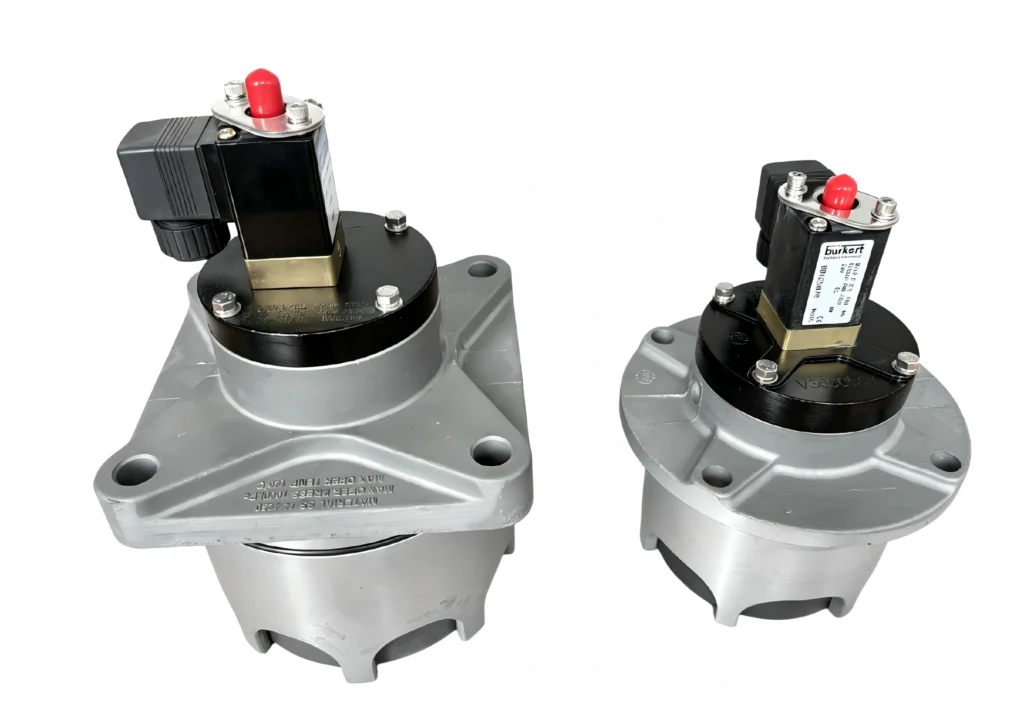
OPTIPOW 105 and OPTIPOW 135
Two commonly encountered OPTIPOW configurations are the OPTIPOW 105 and OPTIPOW 135.
The numbers refer to the approximate piston diameter and represent different valve configurations designed for different cleaning requirements.
OPTIPOW 105
The OPTIPOW 105 is a compact piston pulse valve designed for pulse-jet cleaning applications where a reliable and efficient cleaning pulse is required.
A commonly encountered valve identification is V1617803-0100, while related components may include specific plungers, membranes, and sealing parts.
OPTIPOW 135
The OPTIPOW 135 uses a larger piston configuration and is designed for applications requiring a larger cleaning-air pulse.
A commonly encountered identification is V1614718-0100, with associated replacement components such as the V3629022-0100 plunger.
The appropriate valve should always be selected according to the dust collector design, pressure tank arrangement, blow tube configuration, compressed-air requirements, and the original equipment specifications.
Why Use a Piston Pulse Valve?
Piston-type pulse valves offer several advantages for industrial dust collection systems.
1. Fast Valve Operation
The piston mechanism is designed for rapid opening and closing. Fast operation helps produce a strong and short cleaning pulse.
2. Effective Filter Cleaning
A properly selected and adjusted OPTIPOW valve can deliver a concentrated burst of compressed air through the blow tube, helping remove dust from filter surfaces.
3. Compact Design
OPTIPOW valves are designed for industrial dust collection applications where space and installation arrangement are important considerations.
4. Reliable Repetitive Operation
Dust collectors may perform thousands of cleaning cycles during their operating life. A robust valve design is therefore important for maintaining consistent cleaning performance.
5. Suitable for Industrial Applications
OPTIPOW valves can be used in applications such as power generation, cement production, steel processing, mining, and other industries where large quantities of dust must be controlled.
Where Are OPTIPOW Pulse Valves Used?
OPTIPOW piston pulse valves are primarily used in pulse-jet baghouse and dust collector systems.
Typical applications include:
- Power plants
- Cement plants
- Steel mills
- Mining facilities
- Chemical processing plants
- Waste treatment facilities
- Industrial manufacturing
- Bulk material handling
- Large-scale bag filter systems
In these applications, maintaining clean filter media is essential for keeping differential pressure under control and maintaining stable dust collector performance.
OPTIPOW Pulse Valve Maintenance
Although OPTIPOW valves are designed for demanding industrial applications, regular inspection and maintenance are important.
Common maintenance items include:
- Checking the piston or plunger
- Inspecting the membrane
- Checking O-rings and seals
- Inspecting the pilot solenoid valve
- Checking compressed-air quality
- Checking pilot air passages
- Inspecting the valve for air leakage
- Checking the blow tube alignment
- Testing the valve opening and closing action
Compressed air should be sufficiently clean and dry. Contaminated air containing excessive moisture, oil, or particles can contribute to premature wear or malfunction.
Common OPTIPOW Pulse Valve Problems
Several problems can reduce the performance of an OPTIPOW valve.
Valve Does Not Pulse
Possible causes include an electrical control problem, solenoid failure, insufficient pilot air pressure, blocked air passages, or a damaged internal component.
Weak Cleaning Pulse
A weak pulse may be related to insufficient compressed-air pressure, leakage, incorrect blow tube installation, or internal wear.
Valve Leakage
Continuous leakage may indicate worn sealing components, a damaged membrane, piston/plunger problems, or contamination inside the valve.
Piston Does Not Move Correctly
A damaged or contaminated piston/plunger may prevent the valve from opening or closing correctly.
When troubleshooting an OPTIPOW valve, the complete air-cleaning system should be inspected rather than replacing components without identifying the underlying cause.
OPTIPOW Pulse Valve Spare Parts
For long-term operation, having the correct replacement parts available can reduce dust collector downtime.
Common OPTIPOW replacement parts include:
- Piston/plunger
- Membrane
- O-rings
- Rubber disc
- Pilot cover
- Coupling set
- Other sealing and connection components
For example, the OPTIPOW 105 plunger V3630527-0100 and OPTIPOW 135 plunger V3629022-0100 are examples of specific replacement components associated with these valve configurations.
When ordering replacement parts, it is important to check the valve model, part number, dimensions, and application to ensure compatibility.
OPTIPOW Piston Pulse Valve vs. Traditional Diaphragm Pulse Valve
The main difference is the mechanism used to control the compressed-air pulse.
A traditional diaphragm pulse valve uses a flexible diaphragm as the primary opening and closing element. An OPTIPOW piston valve uses a piston/plunger-based mechanism.
The choice between different valve technologies depends on factors such as:
- Dust collector design
- Cleaning-air requirements
- Operating pressure
- Valve size
- Filter type
- Installation arrangement
- Maintenance requirements
For an existing dust collector, replacing one valve technology with another should not be done solely based on valve dimensions. The complete cleaning system should be evaluated.
How to Choose the Right OPTIPOW Valve
Before purchasing or replacing an OPTIPOW pulse valve, check the following information:
- Valve model – OPTIPOW 105 or OPTIPOW 135.
- Original part number – Verify the complete valve identification.
- Connection size – Confirm inlet and outlet dimensions.
- Operating pressure – Check the compressed-air pressure available in the system.
- Pilot solenoid – Confirm voltage and solenoid specifications.
- Blow tube configuration – Make sure the valve matches the existing cleaning system.
- Replacement parts – Check the piston, membrane, O-rings, and other components.
- Application requirements – Consider the filter type and dust collector configuration.
Correct identification is particularly important when replacing an existing valve because similar-looking components may not necessarily be interchangeable.
Conclusion
The ALSTOM OPTIPOW piston pulse valve is an important component in industrial pulse-jet dust collection systems. Its piston-based operating mechanism allows the valve to rapidly release compressed air for effective filter cleaning.
The OPTIPOW 105 and OPTIPOW 135 are two important configurations used in industrial applications. Understanding their working principle, components, maintenance requirements, and replacement parts can help operators maintain reliable dust collector performance and reduce unplanned downtime.
For an existing dust collection system, always verify the OPTIPOW model and original part number before ordering a complete valve or replacement component. Proper valve selection, clean compressed air, correct installation, and regular maintenance are essential for reliable pulse cleaning performance.
About us
At DUSTEK, we specialize in variety type of industrial valves, dust explosion protection devices and filter products specifically designed for the dust collection system. Our product range includes Alstom Optipow 105 and Optipow 135 plunger valves, pulse valve, sequential controller, rotary valve, explosion-isolation valve, spark arrestor, explosion-relief valve, spark alarm, flame arrestor, filter bag, filter cage, filter cartridge, all for the dust collection system.
We are providing one-stop solutions for the dust collection system.