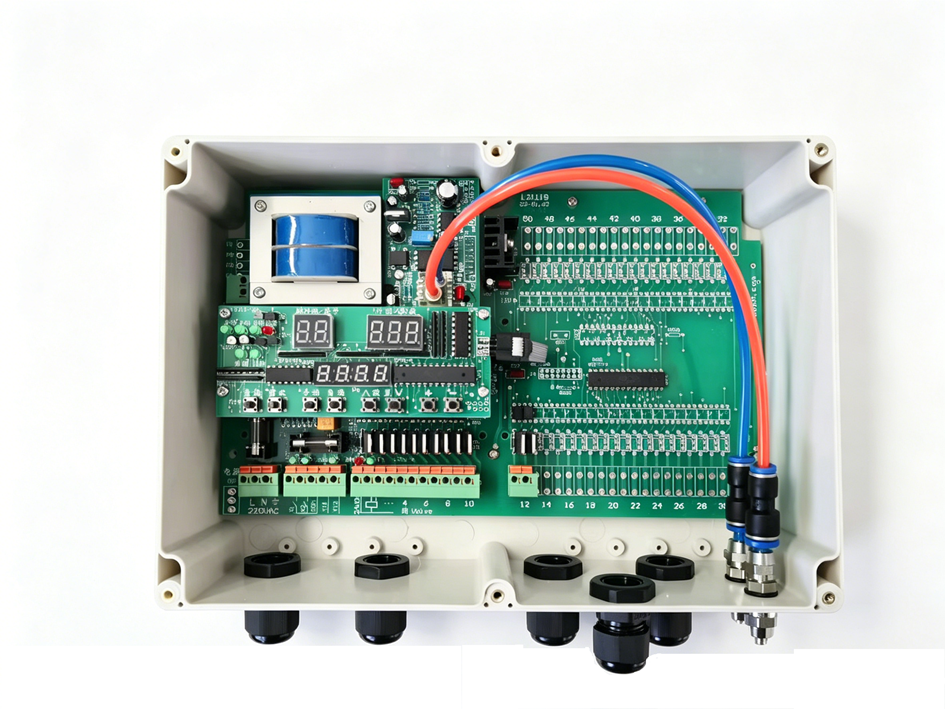

A differential pressure dust collector controller is an electronic control device used to monitor the pressure difference across the filter bags or filter cartridges in an industrial dust collection system. It helps determine when the filters need cleaning and can automatically control the pulse cleaning process.
By continuously monitoring differential pressure, the controller helps maintain stable airflow, improve dust collection efficiency, reduce compressed-air consumption, and extend filter service life.
What Is Differential Pressure?
Differential pressure, commonly written as ΔP, is the difference in air pressure between the dirty-air side and the clean-air side of a dust collector filter.
As dust accumulates on the surface of filter bags or cartridges, airflow resistance gradually increases. This causes the differential pressure across the filters to rise.
The basic relationship is:
ΔP = Dirty-Side Pressure − Clean-Side Pressure
A differential pressure controller uses pressure signals from both sides of the filter to monitor this pressure difference.
How Does a Differential Pressure Dust Collector Controller Work?
The controller is normally connected to pressure sensing lines installed on the dirty and clean sides of the filter chamber.
The operating process can be summarized as follows:
1. Measuring Differential Pressure
The controller continuously measures the pressure difference across the filter media.
When the filters are relatively clean, the differential pressure is usually lower. As dust builds up, the pressure difference increases.
2. Comparing the Pressure With the Setpoint
The controller compares the measured differential pressure with a programmed cleaning setpoint.
For example, when the differential pressure reaches the upper cleaning threshold, the controller can initiate a filter cleaning cycle.
3. Activating Pulse Valves
The controller sends an electrical signal to a solenoid pilot valve. The pilot valve then operates a pulse jet valve, releasing a short burst of compressed air into the filter.
The compressed-air pulse causes the filter bag or cartridge to flex, helping remove accumulated dust from its surface.
4. Monitoring the Pressure Drop
After cleaning, the differential pressure normally decreases. The controller continues monitoring the pressure and can stop or reduce cleaning when the pressure returns to the desired range.
This creates an automatic cleaning cycle based on the actual operating condition of the dust collector.
Why Is Differential Pressure Control Important?
Differential pressure is an important indicator of dust collector performance.
If the differential pressure becomes too high, the filter media may be heavily loaded with dust. Excessive pressure drop can restrict airflow and increase the workload of the exhaust fan.
On the other hand, cleaning the filters too frequently can waste compressed air and may cause unnecessary wear on the filter media.
A differential pressure controller helps balance these two conditions by cleaning the filters when cleaning is actually required.
Main Benefits
A differential pressure dust collector controller can provide several advantages:
- Automatic filter cleaning
- Stable airflow through the dust collector
- Reduced compressed-air consumption
- Improved dust collection performance
- Reduced fan energy consumption
- Extended filter service life
- Reduced manual maintenance
- Real-time monitoring of filter loading
Differential Pressure Control vs. Timer Control
Traditional pulse jet dust collectors may use a timer-based controller to activate pulse valves at fixed intervals.
For example, the controller may send a pulse every few seconds regardless of the actual filter condition.
A differential pressure controller operates differently. Instead of cleaning only according to time, it uses the actual pressure drop across the filters as an indication of filter loading.
| Feature | Timer Control | Differential Pressure Control |
|---|---|---|
| Cleaning method | Fixed time interval | Based on filter pressure |
| Filter condition monitoring | Limited | Continuous |
| Compressed-air efficiency | Moderate | Generally better |
| Cleaning frequency | Predetermined | Adjusted according to ΔP |
| Automation | Basic | More intelligent |
| Suitable for variable dust loads | Less flexible | More flexible |
For applications where dust loading varies significantly, differential pressure-based cleaning can provide better control of the pulse cleaning process.
What Components Work With a Differential Pressure Controller?
A complete dust collector control system may include several components:
Differential pressure controller → Solenoid pilot valve → Pulse jet valve → Compressed-air cleaning system
The controller provides the electrical control signal. The solenoid pilot valve responds to that signal and controls the pneumatic operation of the pulse valve.
The pulse valve then releases a high-volume burst of compressed air to clean the filter bags or cartridges.
Common pulse valves used in these systems include dust collector pulse valves, diaphragm pulse valves, and piston-type pulse valves, depending on the dust collector design.
Typical Applications
Differential pressure dust collector controllers are widely used in industrial filtration systems, including:
- Cement plants
- Steel and metal processing
- Power plants
- Mining operations
- Chemical processing
- Asphalt plants
- Pharmaceutical manufacturing
- Food processing
- Woodworking
- Material handling
- Industrial baghouse systems
They are especially useful in applications where the dust loading changes during production and automatic filter cleaning is required.
What Happens if Differential Pressure Is Too High?
A continuously increasing differential pressure can indicate several possible problems.
These may include:
- Excessive dust accumulation
- Ineffective pulse cleaning
- Insufficient compressed-air pressure
- Blocked air passages
- Incorrect pulse valve operation
- Damaged or unsuitable filter media
- Excessive dust loading
- Incorrect controller settings
Therefore, differential pressure monitoring can also provide useful information for preventive maintenance.
What Happens if Differential Pressure Is Too Low?
An unusually low differential pressure is not always a sign that everything is operating normally.
Depending on the system, an unexpectedly low pressure drop may indicate:
- Damaged filter bags
- Missing filter elements
- Incorrect pressure sensing connections
- Air leakage
- Improper installation
- Problems with the pressure measurement system
For this reason, differential pressure should be evaluated together with airflow, emissions, fan performance, and other operating parameters.
How to Choose a Differential Pressure Controller
When selecting a controller for a dust collection system, several factors should be considered.
Differential Pressure Range
The controller should have a suitable pressure measurement range for the dust collector.
Number of Outputs
The number of output channels should match the number of pulse valves that need to be controlled.
Cleaning Mode
Some controllers support differential-pressure cleaning, timer-based cleaning, or a combination of both.
Operating Environment
The controller should be suitable for the temperature, humidity, dust, and electrical conditions of the installation environment.
Compatibility
The controller should be compatible with the solenoid pilot valves and pulse valves used in the dust collector.
Conclusion
A differential pressure dust collector controller is an important part of a modern pulse jet dust collection system. By monitoring the pressure difference across filter bags or cartridges, it can determine when filter cleaning is required and control the pulse valves accordingly.
Compared with simple fixed-time cleaning, differential pressure control allows the cleaning process to respond to the actual filter loading condition. This can help maintain consistent airflow, improve system efficiency, reduce compressed-air consumption, and support longer filter life.
For industrial dust collectors, a properly selected differential pressure controller can therefore play an important role in achieving efficient, reliable, and automated filter cleaning.